
There is a specific moment when hiring stops being a dream and becomes a math problem: you are turning down work, your response times are slipping, and the hours you sell are capped by the hours you personally have. If that is you, this guide is the whole process in one place.
Two things make a first hire different from every hire after it. First, the cost is bigger than the salary, and most founders find out late. Second, you become an employer in the eyes of the IRS and your state the moment someone starts, with paperwork deadlines measured in days, not months. We checked every figure and deadline below against IRS guidance and current 2026 rates.
Before anything: can you actually afford an employee?
The salary you negotiate is not what the employee costs. The quick estimate used since MIT’s Joseph Hadzima published it: multiply base salary by 1.25 for a lean setup, 1.4 if you offer real benefits. A $50,000 hire costs your business $62,500 to $70,000 a year.
Here is where the multiplier comes from, at 2026 rates:
| Cost item | $40,000 salary | $55,000 salary | $70,000 salary |
|---|---|---|---|
| Employer FICA (7.65%) | $3,060 | $4,208 | $5,355 |
| FUTA (0.6% on first $7,000) | $42 | $42 | $42 |
| SUTA (new employer, ~2.5% typical) | ~$175-500 | ~$175-500 | ~$175-500 |
| Workers’ comp (office work, ~0.5-1%) | ~$200-400 | ~$275-550 | ~$350-700 |
| Payroll software (~$40/mo + $6/person) | ~$550 | ~$550 | ~$550 |
| True annual cost (before benefits) | ~$44,000-44,600 | ~$60,250-60,850 | ~$76,470-77,150 |
Three notes on this table. FICA is fixed: you match 6.2% Social Security (on wages up to $184,500 in 2026) plus 1.45% Medicare with no cap. SUTA is the wild card: states assign new employers a default rate, commonly 2-4%, on a state wage base that ranges from $7,000 to over $70,000 depending on the state. And benefits change everything: health insurance, retirement match, and PTO push total compensation costs toward 30% on top of salary (BLS put benefits at 29.9% of total compensation for private industry in its December 2025 release).
The revenue test that keeps first hires safe: the role should pay for itself at two to two-and-a-half times its true cost. A $60,000 all-in hire needs to generate or protect roughly $120,000-150,000 of revenue. If the math only works when the employee is “fully ramped,” you cannot afford the hire yet.
The legal setup: do this before you post the job
Four items, none optional, all doable in a week:
- Get an EIN. Free at IRS.gov, about ten minutes online, issued immediately. You cannot run payroll without it.
- Register as an employer in your state. Your state’s revenue or labor department handles employer accounts for income tax withholding and unemployment insurance (SUTA). Every state with income tax requires this.
- Buy workers’ compensation insurance. Required in nearly every state before the employee’s first day (Texas is the famous exception for private employers). Office work runs roughly 0.3-1% of payroll; physical trades run 5-15%+. Skipping it exposes you personally to injury claims.
- Set up payroll software. Gusto, QuickBooks Payroll, and ADP Run are the usual small-business picks. Payroll software calculates withholding, deposits taxes on the IRS schedule, files your state new hire reports, and generates the W-2 at year-end. Doing this manually is how first-time employers end up with failure-to-deposit penalties (2-15% of the amount due).
One warning that saves real money: if your first hire works remotely from another state, that state gets a claim on you. You will need to register as an employer there, withhold its income tax, and pay into its unemployment fund. “They’re just one remote person” is not an exemption.
Day one paperwork: the deadlines are shorter than you think
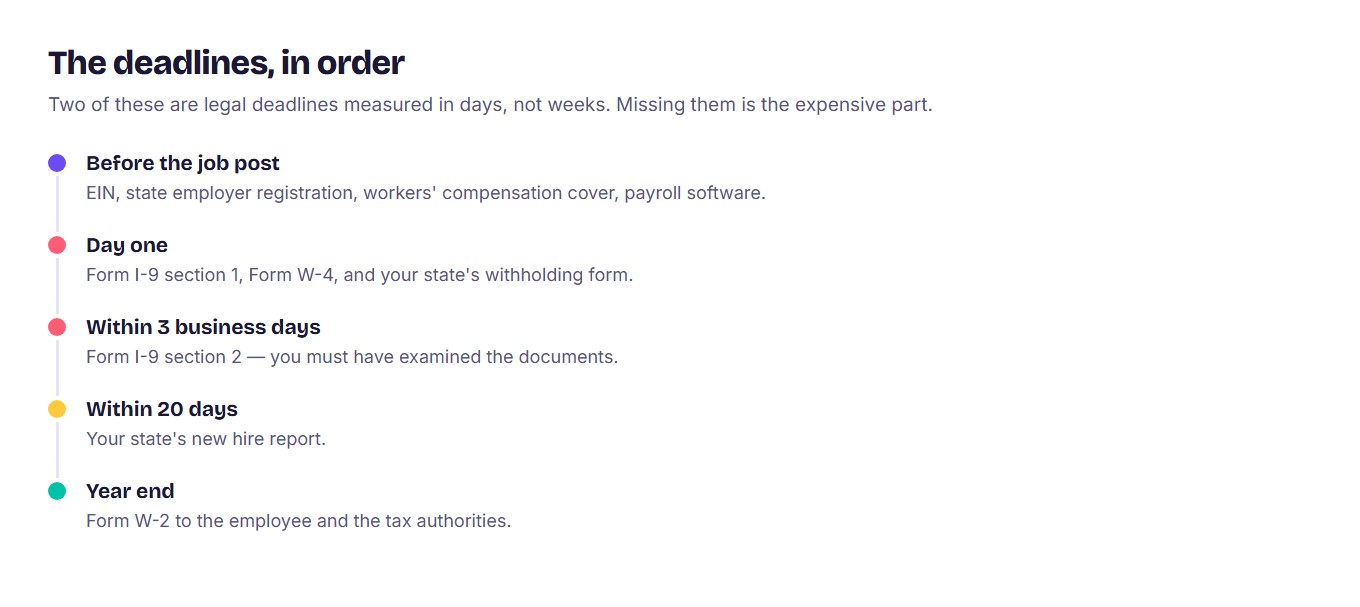
This is where first-time employers get fined, because the clocks start the moment your hire walks in:
- Form I-9 (work eligibility). Section 1 must be completed by the employee on or before day one. You must physically examine their original documents and complete Section 2 within 3 business days. This is the most commonly botched form in small business and it carries the heaviest penalties. Some states also require E-Verify; check yours. (I-9 Central at USCIS walks you through it.)
- Form W-4 (federal withholding). Completed on or before the first day, effective with the first paycheck. No W-4 means you withhold at the default single rate, which employees notice and hate.
- State withholding form. 43 states have their own version; the federal W-4 alone is not enough in most of the country.
- State new hire report. All 50 states require you to report the hire to a state directory within 20 days. Most payroll software files this automatically; if yours does not, put it on the calendar.
Keep every employment tax record for at least four years. And send what you can before day one: W-4, state form, direct deposit authorization, and your one-page house rules can all go out digitally during the offer stage, leaving only the I-9 document check for the first morning.
Employee or contractor? Decide honestly
The temptation is real: a 1099 contractor needs no payroll, no workers’ comp, no unemployment insurance, no benefits. So founders call their first hire a contractor and control them like an employee.
The IRS test is behavioral and financial control. If you set their hours, provide their tools, direct how the work is done, and they work mainly for you, that is an employee regardless of what the contract says. Misclassification means back taxes on the employer share of FICA, plus penalties, plus state exposure. A genuine contractor runs their own business, serves other clients, sets their own schedule, and bills for results. If that description makes you say “that’s not what I want,” you want an employee.
Finding and choosing the person
Average cost per hire in the US runs about $4,700 (SHRM’s 2026 benchmarking), with a median around $1,300 for non-executive roles and roughly 40 days to fill. Small companies beat those numbers because founder-led hiring is fast, but only if the process is tight:
- Write the job as outcomes, not duties. “Own our client onboarding end to end” beats a list of 14 responsibilities. One paragraph on what they own, one on what success looks like in 90 days.
- Screen with a paid work sample. Two to four hours on a real problem from your business, paid $200-500. You learn more from watching someone work than from any interview question ever written.
- Call references and ask one question. “Would you hire this person again?” The pause before the answer is the answer.
- Move fast. A bad hire costs 30-50% of a year’s salary by Department of Labor estimates, but a slow process costs you the candidate. Three rounds maximum, decision inside two weeks.
The first 90 days
Your new hire’s productivity depends on a document, not a personality: a one-page operating sheet covering hours, communication norms, who approves what, and how work gets handed off. Add a weekly 30-minute one-on-one for the first quarter (an agenda helps; ours keeps them under 30 minutes). Expect three to eight months before full productivity, and judge the hire at day 90 against the outcomes you wrote in the job post, not against vibes.
Download the free first employee checklist (PDF) — the affordability math, the four legal setup steps, the day-one paperwork with its deadlines, and the 90-day plan, on one page with boxes to check. Print it and work through it in order.
Hiring is the start of a new system, not the end of one — and it is only the seventh of the eight systems a founder-led business needs, which comes with a free audit to see which of the other seven a new person will immediately expose. Our work organization tools map covers the six tool categories your new employee will live in, the business management software guide maps the full stack (payroll included), and the project management for small business guide covers how to hand work off without losing it. If this hire means your one-person company just became a team, the team meeting agenda templates will keep your new meetings short.

Frequently asked questions
How much does it cost to hire your first employee?
Budget 1.25 to 1.4 times the salary. On a $50,000 salary, employer FICA adds $3,825, FUTA $42, SUTA and workers’ comp a few hundred dollars each, and payroll software about $550 a year, for roughly $55,000-56,000 before any benefits. Add health insurance and PTO and you approach $65,000-70,000. Recruiting itself averages about $4,700 per hire nationally (SHRM 2026), though founder-led hiring usually comes in far below that.
What paperwork do I need to hire my first employee?
Before the job post: an EIN, state employer registration, workers’ comp insurance, and payroll software. On day one: Form I-9 (Section 1 by day one, Section 2 within 3 business days), Form W-4, and your state’s withholding form. Within 20 days: your state’s new hire report. At year-end: Form W-2.
Can I just hire a contractor instead?
Only if the relationship is genuinely independent: they set their hours, use their tools, serve other clients, and deliver results rather than time. If you control how and when they work, the IRS considers them an employee no matter what the contract says, and misclassification triggers back taxes plus penalties. When in doubt, hire the employee.
Do I need workers’ compensation insurance for just one employee?
Yes, in nearly every state, from the first employee’s first day. Texas is the notable exception where private employers can opt out. Expect roughly 0.3-1% of payroll for office work and 5-15% or more for physical trades. Operating without it exposes you personally to injury claims and state fines.
How long does it take to hire a first employee?
The legal setup takes about a week (EIN is instant, state registration and workers’ comp a few days each). Recruiting averages around 40 days nationally, but a founder with a clear job post, a paid work sample, and fast decisions can close in two to three weeks. Budget three to eight months before the new hire reaches full productivity.
The bottom line
A first employee is a bet that their output will outrun their true cost, wrapped in a legal process with unforgiving deadlines. Neither part is hard once you see it whole: run the 1.25-1.4x math honestly, do the four legal setup steps before you post the job, and treat the day-one paperwork as the deadline-driven compliance work it is.
Print the checklist, do the setup this week, and hire for the bottleneck that is actually costing you revenue.
